

- Posted by Anitox
Improving FCR in Turkeys by Protecting Pellet Quality
A feed mill can produce pellets that meet quality specifications, yet turkeys may consume a substantially different feed form by the time those pellets reach the feeder. Transportation, storage, conveying and feed-line movement can all increase fines, creating a gap between manufactured pellet quality and the feed birds actually consume.
For turkey integrators working to improve feed conversion ratio (FCR), that gap matters. Physical feed quality influences feeding behavior and feed efficiency, and turkey-specific research shows that the response can vary considerably across production stages.
The challenge is not simply producing durable pellets. It is preserving their integrity throughout the feeding system.
Learn More about the Importance of Pellet Quality Today.
How much does pellet quality influence turkey FCR?
In a controlled study involving 816 Nicholas Select male turkeys, Flores et al. (2021) evaluated diets differing in fines content alongside several litter treatments.
Over the 20-week production period, turkeys receiving feed with fewer fines achieved an FCR of 2.20 compared with 2.31 for birds receiving feed with more fines. Cumulative feed intake was also lower, at 45.6 versus 48.1 kg per bird.
Although birds receiving fewer fines were heavier at several intermediate measurements, the difference in final body weight at 20 weeks was not statistically significant.
These findings provide experimental evidence that pellet quality can influence feed efficiency independently of final market weight. However, the reported FCR values reflect specific study conditions, not a universally achievable improvement.
For commercial operations, the more useful question is whether variation in pellet integrity contributes to differences in feed intake and efficiency between flocks, houses or production phases.
Does production stage change the response?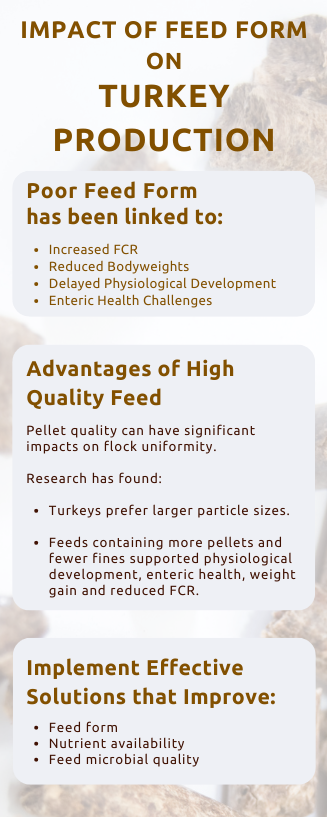
Evidence suggests it does.
Poholsky et al. (2023) evaluated diets containing approximately 60% or 90% pellets across three experiments with Nicholas Select hens and toms.
In hens, diets containing 90% pellets improved FCR between 13 and 16 weeks in two experiments. For toms, performance benefits were observed primarily between 4 and 14 weeks, with differences becoming less apparent as birds approached market age.
These results suggest that the value of improved pellet quality is not necessarily distributed evenly across the production cycle.
Rather than treating pellet durability as a fixed target with a uniform performance response, integrators can evaluate where feed-form deterioration overlaps with periods of greater sensitivity.
What happens between the mill and the feeder?
Pellet durability index (PDI) and fines measured at mill discharge provide useful manufacturing benchmarks. They do not necessarily describe the physical feed available to turkeys after delivery.
Flores et al. (2021) documented additional pellet breakdown through feed handling and distribution. Across feeding phases, diets manufactured with fewer fines averaged approximately 29% fines at the feeder, compared with 57% in diets prepared with more fines.
That difference highlights a practical measurement challenge. Feed quality can change substantially after leaving the mill, meaning discharge samples alone may underestimate the fines birds encounter.
Excessive fines can alter feeding behavior and the time required to consume feed. Physical separation may also affect consistency of nutrient delivery when feed fractions differ in composition.
These are plausible contributors to performance variability, although their relative importance depends on the feeding system and diet.
Where should feed quality be measured?
A useful monitoring approach connects physical feed measurements with performance data at several points:
- Mill discharge: Record PDI, fines percentage and relevant conditioning conditions to establish the manufactured baseline.
- Farm delivery: Compare physical quality before and after transportation, unloading and storage.
- Feeders: Measure fines where birds actually consume feed, including differences between feed lines or houses.
- Production phases: Evaluate feed form alongside body weight, feed intake and phase-specific FCR.
The objective is to identify where deterioration occurs and whether it coincides with measurable performance differences.
Changes to conditioning, moisture management or handling practices should also be assessed against manufacturing efficiency, nutritional quality and operating costs rather than pellet durability alone.
Protecting pellet quality where it matters
Pellet quality measured at mill discharge does not necessarily reflect the feed turkeys consume. Comparing fines at discharge, delivery and the feeder against phase-specific FCR can help identify where physical feed deterioration may contribute to reduced efficiency.
These measurements provide a basis for targeting handling or manufacturing improvements where they are most relevant, rather than assuming that higher pellet durability will produce the same response across every production stage.
To explore opportunities to maintain feed quality from manufacturing through delivery, contact your clean feed expert today.