

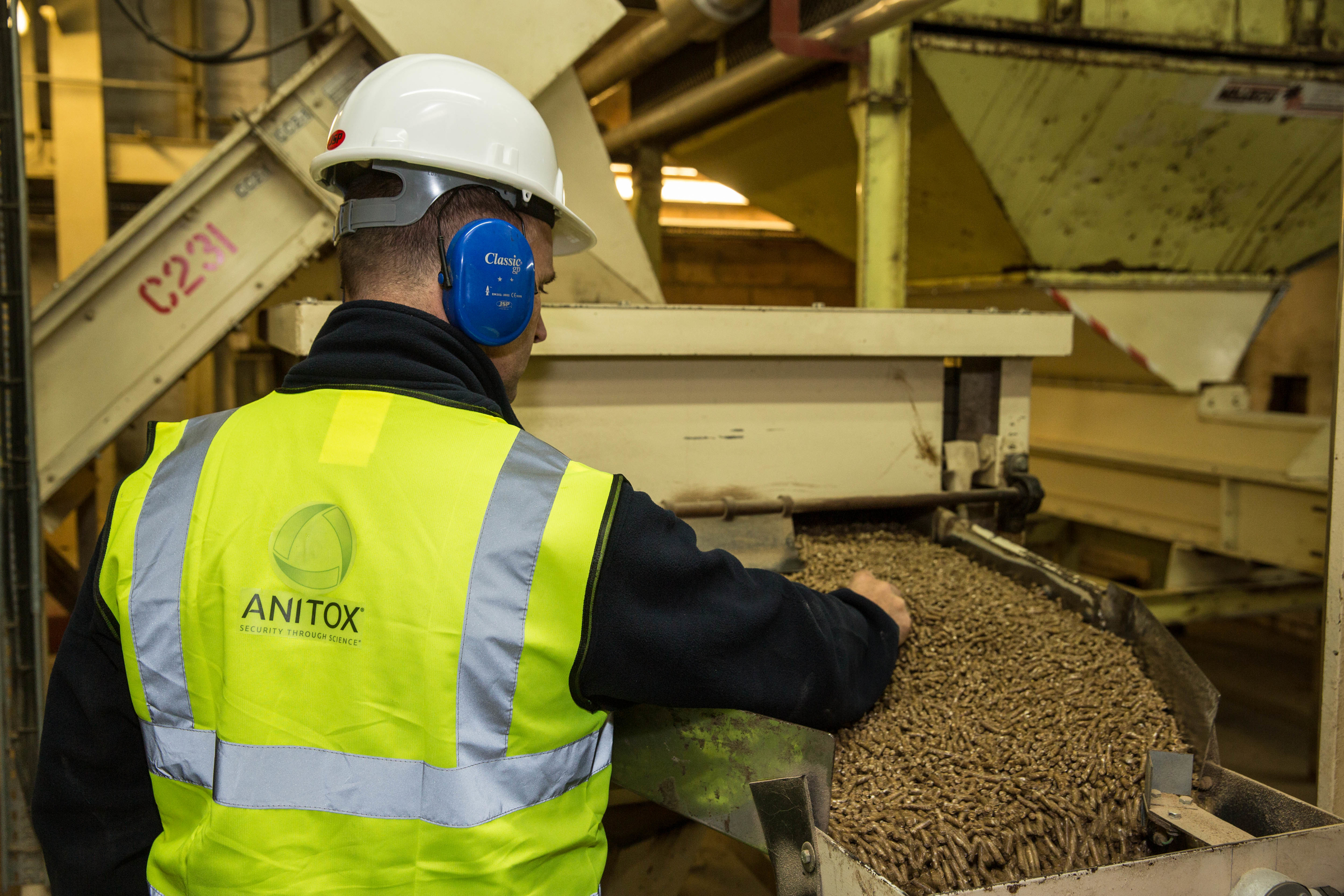
- Posted by Anitox
8 Practical Control Points for Feed Conditioning & Steam Optimization
Steam conditioning is one of the few unit operations in a feed mill that simultaneously affects physical quality (PDI/fines), mill efficiency (kWh/ton, tph) and finished-feed functionality. Done well, it improves moisture absorption, heat transfer and pellet binding; done poorly, it drives variability, die choke and unnecessary nutrient losses.
Get Your Free Guide to Pellet Quality
1) Start with Steam Quality, Not Just Steam Pressure
Steam quality determines how much usable latent heat reaches the mash. In controlled work, higher-quality good, saturated steam reduced the steam flow needed to reach target conditioning temperature versus lower-quality steam, reinforcing why separators, traps and condensate management are not “maintenance nice-to-haves”—they are process controls.
2) Treat Moisture Targets as a Control Loop
Conditioning is ultimately about heat + water moving into particles. Feed-mill guidance consistently emphasizes monitoring mash/conditioned moisture alongside temperature and adjusting steam/water addition based on variability in incoming ingredients and ambient conditions.
3) Optimize Retention Time and Conditioner Fill for Uniform Penetration
Retention time is where steam becomes functionality. It enables particle softening, starch gelatinization and improved binding. Conditioning guidance recommends stable feed flow, retention time of 45 seconds minimum, if possible, and routine inspection of paddles, conditioner cleanout to prevent buildup that reduces effective retention and creates “short-circuiting.”
4) Choose Temperature to Match the Job
Higher conditioning temperatures generally improve pellet quality, but they can also reduce activity of exogenous enzymes at the upper end. A Poultry Science study found pellet quality increased as conditioning temperature increased, while enzyme activity dropped at higher temperatures (e.g., 88°C), illustrating why “hotter” is not always “better” if enzyme efficacy is part of the value proposition. In addition, different formulas matrices behaves differently to conditioning temperatures.
5) Don’t Ignore the Room: Ambient Temperature Changes the Pelleting System
Steam addition and moisture dynamics don’t occur in isolation. Recent work evaluating ambient temperature effects alongside conditioning temperature shows meaningful interactions that influence moisture addition and downstream outcomes—especially relevant for mills dealing with winter/summer swings.
%20(300%20x%20175%20px)%20(16)-1.png?width=300&height=175&name=Untitled%20(175%20x%20300%20px)%20(300%20x%20175%20px)%20(16)-1.png) 6) Engineer for Pellet Integrity by Improving Moisture Distribution and Retention
6) Engineer for Pellet Integrity by Improving Moisture Distribution and Retention
Pellet durability is strongly influenced by how effectively moisture penetrates the mash and carries heat uniformly. Industry discussions often point out that improving moisture penetration and retention supports more uniform gelatinization and stronger particle binding—reducing fines and improving feed form stability.
7) Track What Matters: Temperature, Moisture and Variability KPIs
If you can’t see it, you can’t optimize it. Practical KPI frameworks for mill managers emphasize tracking steam-related variables (e.g., conditioning temperature/pressure signals), shrink and throughput to identify drift and root causes early—before quality or efficiency losses compound.
8) Remember the Downstream Steps%20(300%20x%20175%20px)%20(15)-1.png?width=300&height=175&name=Untitled%20(175%20x%20300%20px)%20(300%20x%20175%20px)%20(15)-1.png)
Conditioning/pressing may raise moisture and temperature, but cooling and storage determine whether the finished feed remains stable. Moisture migration and condensation risk during cooling/storage can create localized spoilage pressure and quality losses—making cooler performance and storage hygiene part of “steam optimization,” not a separate topic.
Feed conditioning and steam optimization works best as a system—steam quality, moisture control, retention time, temperature selection, and downstream cooling/storage all have to align to deliver consistent pellets and predictable mill performance.
Learn more about how Maxi-Mil can aid your feed mixing operation in reaching its quality, efficiency and profitability goals by contacting one of our Clean Feed Experts today.